Thermal Label Printers for Small Businesses: A South African Buyer’s Guide
If you’re still writing prices on masking tape or printing labels on A4 sticker sheets that jam halfway through, a thermal label printer can save you hours a week. But “label printer” covers very different machines, from a palm-sized Bluetooth printer for price tags to a desktop unit built for courier waybills. Buy the wrong one and it sits in a drawer.
This guide explains how thermal printing works, which label sizes match which jobs, what South African courier platforms expect for waybills, and how to work out your running costs before you spend a cent.
How a thermal label printer works
A thermal printer has no ink cartridges. It prints with heat, and there are two ways it can do that.
Direct thermal
The label itself is coated with a heat-sensitive layer. Where the print head heats it, the coating turns black. Zebra’s printer documentation compares direct thermal media to fax paper and notes it is typically used for receipts and tickets. Your till slip is the everyday example.
The upside: the only thing you ever buy is labels. The downside: the print is sensitive. Heat, sunlight, scratching and moisture can darken or fade it, and UK label supplier Labelzone puts the typical shelf life of direct thermal print at under a year, and that’s if it’s kept away from heat and sun.
Thermal transfer
Here the print head melts ink from a ribbon onto the label. The same Labelzone guide explains that this gives a crisper, much longer-lasting print that copes better with liquids and temperature changes. That’s why it’s used for asset tags, cable markers and labels that must survive outdoors. You pay for it with a second consumable (the ribbon) and a bigger, pricier printer.
Which one does a small business need?
For most small shops, direct thermal is the sensible choice. Price tags, shelf labels, barcode stickers, “best before” dates and courier labels all have a short working life. Choose thermal transfer only if your labels must last for years or face harsh conditions, such as labels on outdoor equipment or products stored in a cold room.
Quick test: not sure what kind of labels you have? Zebra suggests scratching the label quickly and firmly with a fingernail. If a black mark appears, it’s direct thermal and needs no ribbon.
Label sizes: match the printer to the job
Label size is the decision that matters most, because a printer can only take rolls up to a certain width. Think about what you’ll print most often.
Small labels (around 40 × 30 mm)
This size suits:
- price tags on shelves or products
- barcode labels for stock you scan at the till
- ingredient, flavour or scent labels on jars, candles and cosmetics
- “made on” or “best before” date labels
- small branding labels with your shop name and social handle
Large labels (around 100 × 150 mm)
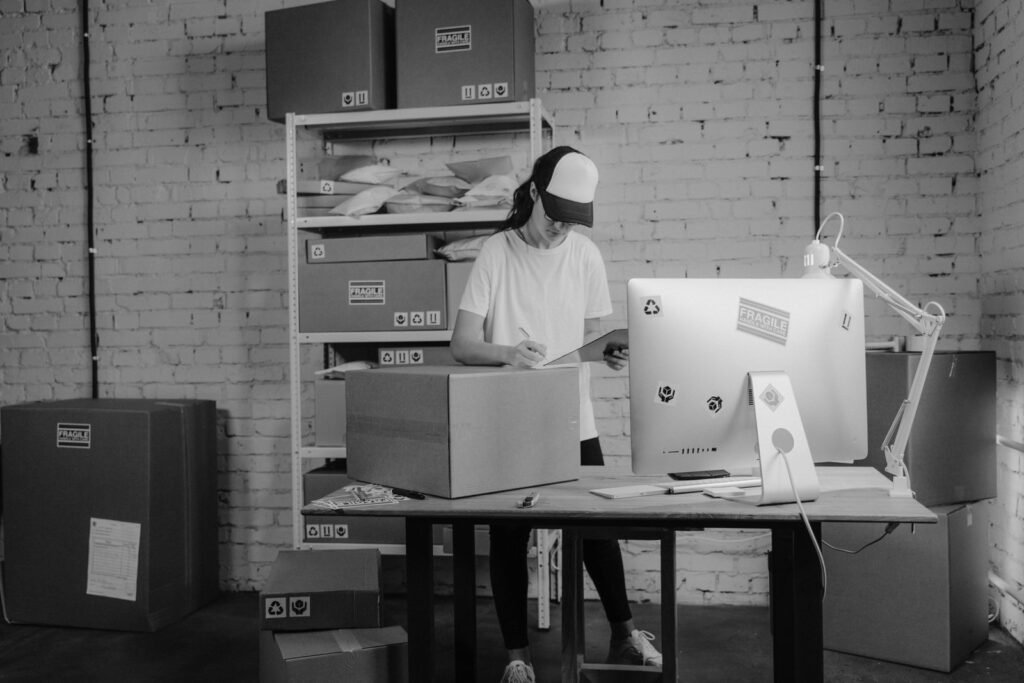
This is courier territory. Bob Go, the South African shipping platform used by many online stores, lists its sticker waybills at 150 mm × 102 mm on the outside, with a 127 mm × 84 mm peel-off area inside. That’s more than 12 times the area of a 40 × 30 mm label.
Be honest about what a small printer can do
A compact printer that takes 40 × 30 mm labels is excellent for product, price and barcode labels. It isn’t a waybill printer. You can’t fit a full courier waybill, with its addresses, tracking barcode and routing details, onto a label that size, and you shouldn’t try to shrink one. A barcode the courier’s scanner can’t read will slow your parcel down, or stop it altogether.
If you ship a lot of parcels, you’ll eventually want both: a small printer at the counter or packing table for product labels, and a larger desktop printer for waybills. Bob Go, for example, lists the specific thermal and Zebra models it has tested for its sticker waybills, and its printer setup guide describes a USB or network connection to a computer. Pargo offers a desktop LabelPrint app and browser printing from MyPargo for bulk waybills. Before you buy anything for shipping, check what your own courier or shipping platform supports.
Printing barcodes that actually scan
If you plan to sell through a retailer or scan stock at your till, barcodes need care.
- Get proper numbers if retailers need them. GS1 South Africa describes itself as the official supplier of barcodes in South Africa. If a store or marketplace asks for a registered barcode (EAN-13), get your numbers from GS1. For internal stock control only, your own SKU codes are fine.
- Respect the minimum size. A standard EAN-13 barcode is about 37.3 mm wide at full (100%) size. GS1 New Zealand gives the acceptable range for retail items as 80% to 200% of that size. On a 40 mm-wide label, that leaves very little room for anything else, so keep the rest of the label simple.
- Don’t cut the bars short. The iDPRT barcode size guide warns against cropping the barcode’s height to make it fit.
- Test before you print 200. Print one label and scan it with your till scanner or a phone app before you label a whole shelf.
What a thermal label printer really costs to run
The printer is a once-off cost. Labels are what you pay for every month. Use this simple sum with your own supplier’s prices:
Cost per label = price of one roll ÷ number of labels on the roll
Then multiply by how many labels you use a month. For example (illustrative numbers, not a quote), if a roll of 500 labels costs R60, each label costs 12c. At 1,000 labels a month, that’s R120 a month in labels.
Other running costs to factor in:
- Ribbons, but only for thermal transfer printers. Direct thermal printers don’t use any.
- Charging, for portable Bluetooth printers. Keep a cable at the packing table.
- Wasted labels, from test prints and misaligned rolls. Budget a few extra per roll, especially while you’re learning.
- Your time, which is the real saving. Typing a price once on your phone and printing 50 identical labels beats writing them by hand.
Label rolls come in different core sizes and widths, so check that a roll fits your printer before you buy in bulk. A cheap roll that doesn’t fit isn’t cheap.
A buyer’s checklist
Before you buy any thermal label printer, run through this list:
- What will I print most? Product and price labels point to a compact printer. Courier waybills point to a 100 mm-wide desktop printer.
- Which label sizes does it take? Check the maximum width and whether the sizes you need are easy to buy locally.
- How does it connect? Bluetooth and a phone app suit market stalls and small counters. USB or network suits a desk with a computer and shipping software.
- Does it work with my phone or platform? Check Android and iOS support, and whether your courier platform supports the printer if you plan to use it for waybills.
- Direct thermal or thermal transfer? Direct thermal for short-life labels, thermal transfer for labels that must last.
- What’s my cost per label? Do the sum above before you commit.
Where our P50 printer fits
Our Portable Thermal P50 Label Printer is a Bluetooth printer that works with Android and iOS and prints 40 × 30 mm labels. That makes it a good match for the first list above: price tags, barcode and stock labels, product and ingredient labels, and small branded stickers for your packaging. It isn’t designed for full A6 courier waybills, so if you ship daily, pair it with whatever waybill printing your courier platform recommends.
Labels are one part of a product that looks professional. If you’re setting up a shop from scratch, our step-by-step guide to starting an online store in South Africa covers the rest of the setup. Our post on writing product descriptions that sell will help you decide which details belong on the label and which belong online. Our guide to customer retention strategies has ideas for what to tuck into the box next to the product.
Your action for today: count how many labels you wrote or printed by hand last week, note which sizes they were, and use the checklist above to decide which printer, or which two printers, your business actually needs.
Frequently asked questions
Do thermal label printers need ink?
No. Direct thermal printers use heat-sensitive labels and need no ink, toner or ribbon, so labels are your only consumable. Thermal transfer printers also have no ink cartridge, but they use a ribbon that the print head melts onto the label. Most small businesses printing price, product or courier labels use direct thermal printers for this reason.
How long do direct thermal labels last?
Direct thermal print is sensitive to heat, sunlight, moisture and scratching, and can fade or darken over time. One label supplier puts typical shelf life at under a year when kept away from heat and sun. That’s fine for price tags and courier labels. For labels that must last years or go outdoors, use thermal transfer printing.
Can I print courier waybills on a 40 × 30 mm label printer?
Not properly. Courier waybills carry addresses, tracking barcodes and routing details, and platforms such as Bob Go use sticker waybills of about 150 × 102 mm. A 40 × 30 mm printer is built for product, price and barcode labels. Use a 100 mm-wide printer, or whatever your courier platform supports, for waybills.
What size label do I need for a barcode?
A standard EAN-13 barcode is about 37.3 mm wide at full size. Retail items can usually be printed between 80% and 200% of that. A 40 mm-wide label can hold one, but only just, so keep the rest of the label minimal and always test-scan a label before printing a full batch.
Do I need GS1 barcodes for my products?
Only if a retailer or marketplace asks for registered barcodes. GS1 South Africa is the official supplier of barcodes in South Africa. If you only scan stock in your own shop, you can create your own internal SKU codes and print them as barcodes without registering anything.
Free weekly marketing tips
Get practical marketing ideas for South African small businesses
One short email a week: a tactic you can use, a tool worth trying, and what is working for local brands. No spam.