How Do NFC Business Cards Work? A Plain-English Guide

An NFC business card looks like an ordinary plastic card, but there’s a tiny chip and antenna inside. Hold a phone against it and a link opens: your website, your Instagram page or your Google review form. So how do NFC business cards work, and are they worth it for a small business? This guide explains the technology in plain English, which phones can read the cards, what you can link to, the privacy basics and when a QR code does the job just as well.
NFC in two minutes
NFC stands for near-field communication. It’s a short-range radio technology that runs at 13.56 MHz. The NFC Forum, the industry body that sets the standards, gives a typical range of up to about 2 cm. That’s why you have to bring the phone right up to the card. It’s a feature, not a flaw: nobody reads your card by accident from across the room.
The clever part is power. According to the NFC Forum, one side of an NFC connection can send power to the other, so a tag can work without a battery. The card has no battery. Your customer’s phone powers the chip for the split second it takes to read it.
How do NFC business cards work, step by step
Here’s what happens in the second or so between the tap and the web page:
- The card stores one small message. When the card is set up (or “written”), a link is saved on the chip in a standard format called NDEF (NFC Data Exchange Format).
- The phone wakes the chip. When an NFC-enabled phone comes close, its radio field powers the chip.
- The chip sends its message. The phone reads the NDEF message and looks for a link.
- The phone shows a prompt. On iPhone, Apple’s developer documentation says the system shows a notification and only opens the link when the user taps it. On Android, Android’s NFC documentation says that from Android 17, scanning a web link shows an “open link” notification the user has to interact with.
- The link opens. The browser or the right app loads your page.
The card does nothing on its own. It can’t open an app, install anything or pull data from the phone. It hands over a link and the customer decides whether to open it.
What’s inside: NTAG chips explained
Many NFC cards, stickers and stands sold for marketing use chips from NXP’s NTAG21x family. NXP’s product page and datasheet list three common versions:
| Chip | User memory | Good for |
|---|---|---|
| NTAG213 | 144 bytes | One web link, such as a Google review or website URL |
| NTAG215 | 504 bytes | A longer link with room to spare |
| NTAG216 | 888 bytes | Bigger records, such as longer text |
A normal web link only needs a small part of that memory, so for a business card or review card the chip size matters less than you’d think.
A few other facts from the NXP datasheet are useful when you’re deciding whether to buy:
- Every chip has a unique 7-byte serial number set at the factory.
- Data retention is rated at 10 years, and the memory is rated for 100,000 write cycles. You can change the link many times.
- The chip can be locked permanently so the link can’t be changed, or protected with a 32-bit password.
Our Waterproof Google Review Stickers use an NFC215 chip with 504 bytes, the same user memory NXP lists for NTAG215.
Which phones can read NFC business cards?
This is the question customers ask most, so here’s what the platform documentation says.
iPhone
Apple says iPhone XS and later support background tag reading. That means the phone reads the tag without an app: the customer holds the phone near the card and a notification appears. If the phone is locked, it asks them to unlock first.
Apple lists times when background reading won’t work, even with the screen on:
- The phone has never been unlocked since it restarted.
- Apple Pay Wallet is in use.
- The camera is in use.
- Airplane mode is on.
- An app is already running its own NFC reading session.
Older iPhones don’t read tags in the background. That’s one reason to always include a QR code too.
Android
Android’s NFC guide says Android phones usually look for NFC tags when the screen is unlocked, unless NFC has been turned off in Settings. Two practical points:
- Not every Android phone has NFC. On a Google Pixel, Google’s help page says the setting is under Settings > Connected devices > Connection preferences > NFC. If the NFC setting isn’t there, the phone doesn’t have NFC. Menus differ on other brands, so search Settings for “NFC”.
- The antenna position varies. If nothing happens, move the card slowly across the back of the phone.
What you can link to
Apple’s documentation lists the link types an iPhone can open from a tag without an app: web links (http and https), email (mailto), SMS, phone calls (tel), FaceTime, Apple Maps and HomeKit setup. Custom app link formats aren’t supported in background reading, so stick to standard web links.
In practice, the most useful links for a small business are:
- Your Google review form. The fastest way to ask for reviews at the till. Our guide on how to get Google reviews in South Africa shows you how to find this link.
- A contact page on your own website, with your phone number, email, address, WhatsApp button and a downloadable contact file.
- Your Instagram, Facebook or TikTok profile.
- A booking page or menu.
A tip on contact cards: you can write a contact record (vCard) straight onto a chip, but it isn’t on Apple’s list of link types for background reading. A link to a contact page on your website works everywhere and you can update it any time without rewriting the card.
Another tip: if you might change your link later, point the card to a page you control, such as yourdomain.co.za/review, and redirect that to the destination. If your Google link ever changes, you update the redirect instead of every card.
Privacy and security basics
NFC is simple, which makes the risks easy to understand.
- The card holds only what you put on it. Usually that’s one link. Anyone who taps it can read it, so never put anything private on a chip.
- The card doesn’t collect data. The phone reads the card, not the other way round. The website it opens may use analytics like any other site, so if your landing page collects names or numbers, POPIA applies just as it would on any web form.
- Lock tags in public places. An unlocked sticker on a counter could, in theory, be rewritten by someone with a writing app to point to a different site. Lock the chip after you’ve tested it, or use a password, as NXP’s datasheet describes.
- Check your cards now and then. Tap each card or sticker once a month to make sure it still opens the right page.
NFC vs QR code: which should you use?
| NFC | QR code | |
|---|---|---|
| How it works | Tap the phone on the card | Open the camera and scan |
| Phone support | NFC-enabled phones only (iPhone XS and later reads without an app) | Any phone with a camera |
| Distance | A couple of centimetres | Can scan from a distance if printed large |
| Cost | Needs a chip | Free to print |
| Best for | Face-to-face moments: counters, tables, handing over a card | Flyers, posters, receipts, packaging inserts |
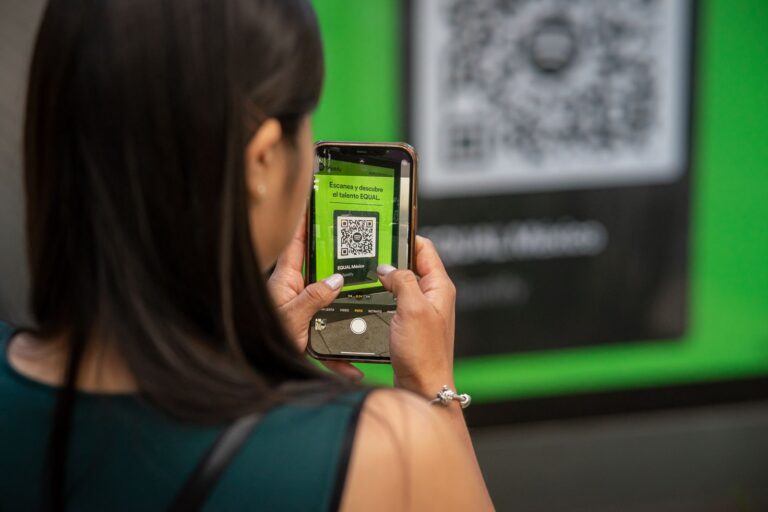
The honest answer is to use both. NFC is quicker when it works, and a QR code covers every phone that doesn’t respond. For a full walkthrough of the QR side, see our guide to setting up a QR code for Google reviews.
Set up your NFC card today: a 15-minute checklist
- Choose one job for the card. Reviews, social follows or contact details. One card, one link.
- Get the exact link. For reviews, copy your review link from your Business Profile (our Google Business Profile setup guide shows where).
- Write the link with a free NFC writing app on an NFC-enabled phone.
- Test on at least two phones, ideally an iPhone and an Android, with the screen unlocked.
- Lock the tag once you’re happy (locking can’t be undone).
- Add a short instruction next to the card, such as “Tap your phone here or scan the code”, and include a QR code with the same link.
- Train your staff to hand the card over at the right moment, such as when the customer says thank you.
Ready to try tap-to-connect?
If you’d like a ready-made card, the Universal NFC Social Media Cards let customers tap to open a link to your Instagram, Facebook or other page on Android and iPhone. For reviews, the NFC Star Rating Card combines an NFC chip and a QR code on black PVC, so every customer can tap or scan.
Frequently asked questions
Do NFC business cards need an app?
Usually not. Apple says iPhone XS and later can read NFC tags in the background without an app: a notification appears and the link opens when you tap it. Most NFC-enabled Android phones read tags when the screen is unlocked and NFC is switched on. Older iPhones don’t read tags in the background, and not every Android phone has NFC, which is why a QR code on the same card is a sensible backup.
Can an NFC card steal information from my phone?
A standard NFC business card is a passive chip with a small amount of memory holding a link. It’s powered by your phone for a moment and sends that link; it doesn’t read your contacts, photos or banking details. Your phone shows a notification before opening the link. As with any link, only open it if you trust where it came from, and treat the website like any other.
Can I change the link on my NFC card later?
Yes, as long as the chip hasn’t been locked. NXP rates NTAG21x chips for 100,000 write cycles, so you can rewrite the link with a writing app. Once a chip is permanently locked, it can’t be changed. To keep flexibility and stay secure, point the card to a page on your own website and change the redirect behind it instead of the card.
Why won’t my phone read the NFC card?
Check that the phone has NFC and that it’s switched on (on Android, search Settings for “NFC”). Unlock the screen, close the camera and Wallet apps on iPhone, and turn off airplane mode. Then move the card slowly across the back of the phone, because the antenna position varies by model. Taking off a thick cover can also help.
How long do NFC cards last?
NXP rates the data on its NTAG21x chips to last 10 years. In practice, the card’s physical condition matters more: a cracked card or a sticker on a hot, heavily cleaned surface can fail sooner. Test your cards monthly and replace any that stop responding.
Free weekly marketing tips
Get practical marketing ideas for South African small businesses
One short email a week: a tactic you can use, a tool worth trying, and what is working for local brands. No spam.